
Community Development Grants | United Kingdom
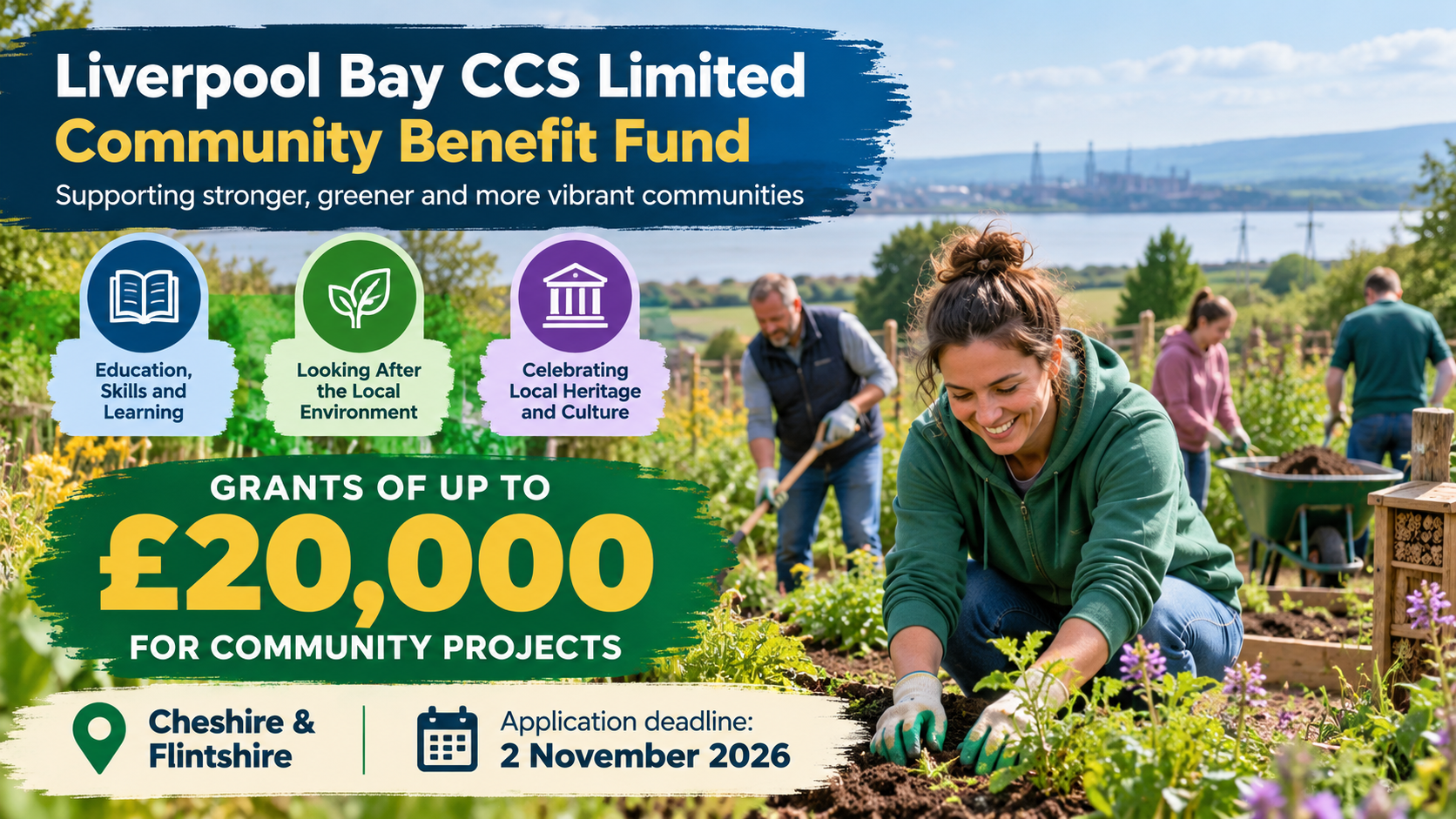
Liverpool Bay CCS Limited Community Benefit Fund: Grant Opportunities of Up to £20,000 for Community Projects
Charities and eligible not-for-profit organisations working in selected communities across Cheshire, England, and Flintshire, Wales, can explore a new community funding opportunity designed to support education, environmental improvement, and local heritage and culture.
The Liverpool Bay CCS Limited Community Benefit Fund is a four-year community investment programme running from 2026 to 2029. Its first funding round supports locally led projects that address community needs and create lasting benefits for residents.
Grant Opportunity at a Glance
Funding programme: Liverpool Bay CCS Limited Community Benefit Fund
Maximum grant: Up to £20,000 in the Cheshire programme; confirm the applicable award limit for Flintshire with Community Foundation Wales.
Eligible applicants: Charities and recognised not-for-profit organisations meeting the relevant foundation’s requirements.
Geographic coverage: Selected communities in Cheshire West and Chester and Flintshire.
Priority themes: Education, local environmental improvement, and heritage and culture.
Project duration: Up to 12 months.
Application opening date: 9 September 2026 at 12:00 noon.
Application deadline: 2 November 2026 at 12:00 noon.
Expected decisions: February 2027; check the relevant foundation for its latest timetable.
Application method: Online through the appropriate community foundation.
About the Liverpool Bay CCS Community Benefit Fund
The Liverpool Bay CCS Limited Community Benefit Fund was established to provide long-term investment in communities located near the company’s carbon dioxide transportation and storage infrastructure. The programme is delivered in partnership with Cheshire Community Foundation and Community Foundation Wales.
The infrastructure forms part of the HyNet North West industrial decarbonisation cluster, which aims to transport carbon dioxide from industrial sources and store it permanently beneath Liverpool Bay. Alongside this wider infrastructure project, the community fund is intended to create social, environmental, educational, and cultural benefits for people living in the surrounding areas.
The initial programme runs from 2026 to 2029. The current opportunity relates to the first year of funding and is intended to support practical projects that respond to identified local needs.
Organisations should consult the official guidance before preparing an application because eligibility, the application route, and local priorities depend on where the proposed project will take place.
How Much Funding Is Available?
The Cheshire Community Foundation programme advertises grants of up to £20,000 for eligible community projects. Applicants should not assume that every successful organisation will receive the maximum amount. Awards will depend on the proposed project, its budget, its expected benefits, and the available funding.
The fund expects to support approximately six to seven projects in Cheshire and six to seven projects in Flintshire during the relevant annual round, although the final number will depend on the quality and size of applications received.
The official Flintshire guidance should be checked separately for the amount available to applicants applying through Community Foundation Wales. Do not assume that the same individual award limit applies in both locations without confirming the applicable terms.
What should the grant cover?
Funding is intended to contribute to the direct costs of delivering eligible projects. Applicants should prepare a proportionate budget that explains how the requested amount will be used and how each proposed expense contributes to the project’s objectives.
The application should make clear which activities will be delivered, how many people are expected to benefit, what outcomes will be measured, and how the project will be completed within the permitted period.
Three Main Funding Priorities
1. Education, Skills and Learning
The fund welcomes projects that improve access to education, develop useful skills, increase knowledge, or encourage lifelong learning. Activities should be relevant to local needs and provide clear benefits to participants.
Examples of potentially suitable activities include:
- After-school learning, homework clubs, and educational support.
- Adult education and basic skills development.
- Digital inclusion programmes that help residents develop digital skills.
- Science, technology, engineering and mathematics activities.
- Arts, music, reading, literacy, and creative learning projects.
- Career guidance, mentoring, and employability workshops for young people.
- Financial literacy, wellbeing, and practical life-skills education.
- Community learning activities bringing together different generations.
- Community libraries and local reading initiatives.
An effective education proposal should explain the learning need being addressed, who will participate, how activities will be delivered, and what improvements participants are expected to make. Applicants may also describe how the project will continue to benefit the community after the grant-funded activities end.
2. Looking After the Local Environment
Environmental projects should help protect, improve, or celebrate local natural spaces. The fund is interested in practical activities that encourage environmental responsibility and enable residents to participate in caring for their surroundings.
Examples include:
- Creating or improving community gardens, orchards, and allotments.
- Wildlife conservation and biodiversity improvement activities.
- Pollinator-friendly planting and habitat restoration.
- Community clean-ups involving rivers, canals, parks, and woodlands.
- Improving access to green spaces, nature trails, and local footpaths.
- Recycling, waste reduction, and environmental awareness campaigns.
- Citizen science projects involving local wildlife observation.
- Volunteer programmes focused on improving natural spaces.
Applicants should explain the environmental issue they want to address and describe the improvements expected from the project. Where appropriate, proposals can include measurable outcomes such as the area of habitat improved, the number of volunteers involved, the number of community activities delivered, or participation in environmental education.
3. Celebrating Local Heritage and Culture
The third priority supports projects that preserve, celebrate, or promote the heritage, culture, history, and identity of local communities.
Potential project ideas include:
- Local heritage exhibitions and community cultural festivals.
- Recording oral histories and preserving local stories.
- Digital archives and local history collections.
- Traditional arts, crafts, music, and performance activities.
- Cultural programmes that encourage participation across communities.
- Heritage education activities for schools and community groups.
- Local museum and history society initiatives.
- Heritage trails, interpretation boards, and digital heritage resources.
A strong proposal should explain why the heritage or cultural activity matters locally, how residents will participate, and how the project will help preserve knowledge, strengthen community identity, or make local culture more accessible.
Projects may address more than one priority. For example, a community heritage garden could combine environmental improvement with intergenerational education and the preservation of local traditions.
Who Is Eligible to Apply?
The fund is designed for charitable and not-for-profit organisations that meet the minimum requirements of the relevant community foundation and deliver projects benefiting eligible communities.
Applicants should be prepared to demonstrate that their organisation:
- Is a registered charity or recognised not-for-profit organisation.
- Has an appropriate governing document.
- Operates in accordance with the applicable foundation’s eligibility requirements.
- Will deliver a project benefiting people in an eligible geographic area.
- Has the capacity and experience to manage the proposed project.
- Can provide a clear project plan and realistic budget.
- Can demonstrate a clear public benefit.
- Meets applicable safeguarding and other minimum organisational standards.
Community groups should check whether their legal structure and governing documents meet the relevant foundation’s requirements before investing time in an application.
Can individuals apply?
No. The published programme criteria exclude applications made on behalf of individuals. This opportunity is intended for eligible organisations rather than personal requests for financial assistance.
Can organisations outside the United Kingdom apply?
This is a geographically restricted community fund. The proposed project must benefit eligible communities in Cheshire or Flintshire and meet the relevant foundation’s requirements. Organisations based elsewhere should not assume they qualify merely because they deliver charitable work internationally.
If an organisation is based outside the eligible area but works in partnership with a local organisation, it should contact the relevant foundation to confirm whether its proposed arrangement is acceptable before applying.
Eligible Locations
The fund is administered through two separate application routes. Applicants must choose the route that corresponds to the location where their project will be delivered.
Cheshire, England
Cheshire Community Foundation administers funding for selected wards in the Cheshire West and Chester area, including communities around Chester, Ellesmere Port, Neston, Frodsham, and Helsby.
The published eligible wards include:
- Parkgate
- Neston
- Little Neston
- Willaston & Thornton
- Saughall & Mollington
- Ledsham & Manor
- Netherpool
- Sutton Villages
- Strawberry
- Whitby Park
- Central & Grange
- Westminster
- Whitby Groves
- Wolverham
- Gowy Rural
- Blacon
- Upton
- Chester City & The Garden Quarter
- Newton & Hoole
- Handbridge Park
- Lache
- Great Boughton
- Frodsham
- Helsby
The programme identifies Gowy Rural and Saughall & Mollington as particular areas of interest. Applicants should consult the official Cheshire guidance to confirm the exact geographic requirements for their project.
View the official Cheshire eligibility information
Flintshire, Wales
Community Foundation Wales administers the Flintshire strand of the fund. Applications must benefit communities in Flintshire, with priority potentially given to work in the following areas:
- Queensferry and Sealand
- Hawarden: Mancot
- Hawarden: Aston
- Hawarden: Ewloe
- Northop
- Flint: Coleshill and Trelawny
- Brynford and Halkyn
- Caerwys
- Whitford
- Llanasa and Trelawnyd
These are priority areas identified in the published guidance. Organisations delivering work elsewhere in Flintshire should review the official criteria to determine whether their proposal is eligible.
What Projects Are Unlikely to Be Funded?
Applicants should review the exclusions carefully before preparing a proposal. The published criteria state that the fund will not support:
- Projects promoting political or religious beliefs.
- Applications submitted on behalf of individuals.
- Activities intended to build organisational reserves or surpluses.
- Ongoing staffing costs without an identified sustainable source of future funding.
- Vehicles, electrical items, or other ongoing operational costs without evidence that they will be self-sustaining after the grant period.
- Work that has already taken place or will have taken place before the grant is awarded.
These exclusions are not a substitute for reviewing the complete programme brief and the relevant foundation’s grantmaking policy. Other restrictions or conditions may also apply.
How Projects Will Be Assessed
Eligible applications will be assessed against the fund’s aims, priorities, and published criteria. Applicants should make their proposals easy to evaluate by clearly explaining the need for the project and the benefits it will create.
The main assessment considerations include:
- Alignment with priorities: How well the project supports education, environmental improvement, or local heritage and culture.
- Community need: Evidence that the proposal addresses an identified local issue or unmet need.
- Expected impact: The benefits the project will deliver for residents and the wider community.
- Delivery capacity: Whether the organisation has the experience, resources, and arrangements needed to deliver the work.
- Project planning: Whether the activities, timetable, responsibilities, and proposed outcomes are realistic.
- Budget and value for money: Whether costs are proportionate, justified, and connected to the proposed activities.
- Sustainability: Whether the project can leave a positive legacy beyond the grant period, where appropriate.
The programme particularly welcomes partnership working, volunteer involvement, participation by local residents, improved access for underrepresented communities, and projects that create lasting community or environmental assets.
How to Prepare a Strong Application
A well-prepared application should demonstrate more than an organisation’s desire to receive funding. It should explain exactly what the project will achieve and why the proposed activities are important to the community.
1. Identify a specific community need
Describe the problem or opportunity your project will address. Where possible, use local information, consultation with residents, feedback from beneficiaries, or evidence from previous activities to explain why the project is necessary.
2. Define your beneficiaries
Explain who will benefit from the project, where they live, and how they will participate. Estimate the number of direct beneficiaries and describe any wider community benefits.
3. Set clear objectives and measurable outcomes
Instead of describing activities only in general terms, identify the results you intend to achieve. An education project might measure participation and improvements in skills, while an environmental project could measure volunteer involvement or improvements to a natural space.
4. Prepare a realistic project budget
Break down the proposed costs and explain why each item is needed. Ensure the total amount requested is justified by the activities and that the project can be completed within the permitted period.
5. Develop a delivery timetable
Explain when the project will start, when its main activities will take place, and when the intended results will be measured. Projects must be completed within 12 months of receiving funding.
6. Explain how the benefits will continue
Where appropriate, describe how volunteers, partnerships, community assets, educational resources, or other project outputs will continue to benefit local people after the funded period ends.
7. Check the required documents
The relevant foundation may require organisational records and supporting information as part of its minimum standards. Check the latest application guidance for the precise document list and format before submitting.
Application Process and Important Dates
The programme uses a single-stage online application process. Applicants should use the appropriate community foundation’s website and follow the instructions provided in its Grants Hub.
| Stage | Date or requirement |
|---|---|
| Applications open | 9 September 2026, 12:00 noon |
| Application deadline | 2 November 2026, 12:00 noon |
| Assessment period | 3 November to 16 December 2026, according to the published Flintshire timetable; confirm the relevant timetable for Cheshire. |
| Funding decisions | Expected in February 2027; check the relevant foundation for the latest date. |
| Project delivery | Projects should commence on receipt of grant funding and be completed within 12 months. |
Step-by-step application instructions
- Confirm that your organisation and proposed project meet the eligibility criteria.
- Check that the project location falls within the relevant geographic area.
- Read the official programme guidance and applicable grantmaking policy.
- Prepare your project description, objectives, delivery plan, and budget.
- Gather the organisational documents and supporting information requested by the foundation.
- Complete the online application using the correct Cheshire or Flintshire application route.
- Review your answers and submit the application before the deadline.
- Monitor communications from the foundation in case further clarification is required.
Monitoring and Reporting Requirements
Successful organisations should be prepared to demonstrate how the funding was used and what difference it made. An end-of-grant report is required when the project is completed.
The report is expected to cover:
- A summary of the activities delivered.
- The outcomes achieved and benefits to participants.
- Case studies, photographs, or other evidence of impact, where appropriate and with the necessary permissions.
- A breakdown of actual expenditure compared with the approved budget.
The community foundations may also arrange visits to funded projects during the grant period. Organisations should maintain appropriate financial records and collect evidence of their activities throughout delivery rather than waiting until the final report is due.
Official Application Links and Contact Information
For projects in Cheshire, England
The Cheshire Community Foundation website provides the official programme information and application route for eligible communities in Cheshire West and Chester.
Visit the Liverpool Bay CCS Limited Community Benefit Fund page at Cheshire Community Foundation
Email:
grants@cheshirecommunityfoundation.org.uk
Telephone: 01606 330607
For projects in Flintshire, Wales
Community Foundation Wales provides the official programme information and Grants Hub route for eligible Flintshire projects.
Visit the Liverpool Bay CCS Limited Community Benefit Fund page at Community Foundation Wales
Email:
grants@communityfoundationwales.org.uk
Telephone: 02920 379580
Applicants who need assistance with the application process can contact the relevant foundation to discuss available support and alternative accessible ways of providing information.
Frequently Asked Questions
What is the maximum grant available?
The Cheshire programme offers grants of up to £20,000. Confirm the applicable award limit and conditions for Flintshire with Community Foundation Wales.
Can a community group apply?
Potentially, provided it is a recognised eligible not-for-profit organisation, meets the relevant minimum standards, and has an appropriate governing document. Informal groups should check their eligibility directly with the foundation.
Can an individual apply for personal financial assistance?
No. Applications on behalf of individuals are excluded under the published criteria. The programme funds eligible organisations delivering community-benefit projects.
What types of projects are supported?
Projects should address at least one of the three priorities: education, environmental improvement, or local heritage and culture. Proposals may combine priorities where appropriate.
How long can a funded project last?
Projects must be completed within 12 months of receiving the grant.
When is the application deadline?
The published deadline is 2 November 2026 at 12:00 noon. Check the official website for any changes before submitting.
When will applicants hear the outcome?
Decisions are expected in February 2027, although applicants should check the relevant foundation’s latest timetable. Submitting an application does not guarantee funding.
Is funding guaranteed once an application is submitted?
No. Applications are assessed against the programme criteria, and awards depend on eligibility, project quality, available funding, and the foundation’s assessment process.
Is there an application fee?
The published programme guidance describes an application through the relevant community foundation. Applicants should follow the official instructions and confirm any questions about costs directly with the foundation. Do not pay an intermediary on the assumption that payment guarantees an award.
Final Advice for Prospective Applicants
The Liverpool Bay CCS Limited Community Benefit Fund offers an opportunity for eligible organisations in selected parts of Cheshire and Flintshire to develop projects with tangible community benefits. Organisations working in education, environmental improvement, and local heritage may wish to review the programme criteria and assess whether their projects meet the requirements.
Before applying, verify your organisation’s eligibility, check your project location, read the complete programme guidance, and prepare a realistic budget and delivery plan. Applications should demonstrate a clear local need, meaningful public benefit, and achievable results within the 12-month project period.
Next step: Visit the official website for the relevant geographic area and follow its application instructions before the published deadline.
Apply via Cheshire Community Foundation Apply via Community Foundation Wales