
📚 Apply Now: Literary Individual Project Funding in Canada – Up to CAD $18,000
Are you a writer, literary artist, or arts administrator in Alberta working on a novel, poetry collection, play, memoir, graphic novel, literary non-fiction project, or another eligible literary project?
The Alberta Foundation for the Arts (AFA) is offering Literary Individual Project Funding to support eligible Alberta artists, arts administrators, and eligible ensembles working on specific literary arts projects.
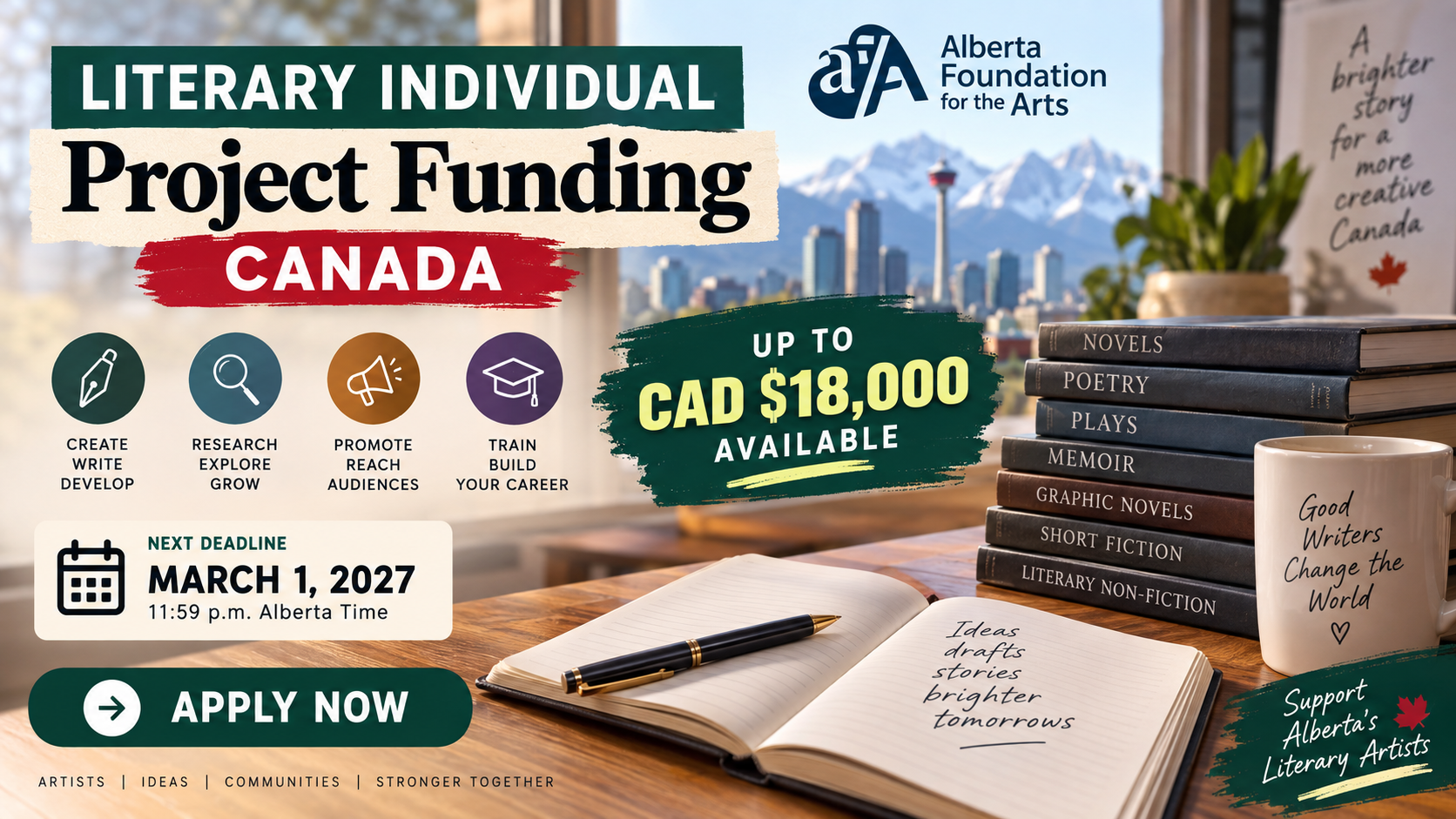
Eligible applicants can request up to CAD $18,000 to support qualifying project expenses. The program can support activities such as artistic production, research, marketing, training, and career development.
💰 Funding at a Glance
- Maximum funding: Up to CAD $18,000
- Program: Literary Individual Project Funding
- Funder: Alberta Foundation for the Arts
- Location: Alberta, Canada
- Eligible applicants: Eligible Alberta individual artists, arts administrators, and qualifying ensembles
- Next listed deadline: March 1, 2027
- Application system: GATE Front Office
📖 What Is Literary Individual Project Funding?
The Literary Individual Project Funding program is designed to support the development of individual Alberta artists, arts administrators, or an ensemble of artists through funding for a specific literary arts project.
Rather than providing unrestricted general funding, the program focuses on a defined project or phase of a project. Eligible activities include art production, marketing, research, and training or career development.
💵 How Much Can You Apply For?
Eligible applicants can request up to CAD $18,000. The AFA states that applicants may request up to 100% of eligible expenses that are directly related to carrying out the proposed project.
The final amount awarded is not automatically the full amount requested. Applications are assessed by an expert panel and recommendations are reviewed by the AFA board.
✍️ What Literary Projects Are Eligible?
The program covers a range of literary genres. Eligible projects include:
- 📕 Novels
- 📝 Short fiction
- 🖋️ Poetry
- 🎨 Graphic novels
- 🎭 Plays
- 📚 Young adult fiction
- 📖 Picture books
- 📰 Literary non-fiction
- 🌍 Literary translation projects
- 📑 Eligible anthology projects
Literary non-fiction can include biography, history, memoir, personal essays, travel writing, literary journalism, and cultural, political, or social commentary, subject to the program’s definition.
🎯 What Activities Can the Funding Support?
1. 📕 Artistic Production
Funding can support the development and creation of literary work. Projects should generally focus on a distinct phase of a work, such as developing a first draft or final draft.
2. 🔎 Research
Research projects can involve experimentation, exploration, and research using primary materials that contributes to the development of new literary work.
3. 📣 Marketing & Promotion
Funding can support activities designed to promote completed literary work and develop audiences or markets.
Examples can include:
- Book launches
- Promotional reading tours
- Online marketing initiatives
- Book trailers
- Attendance at eligible literary festivals
- Invited literary conferences or award presentations
4. 🎓 Training & Career Development
Eligible applicants can also seek funding for professional development activities related to literary arts, including:
- Workshops
- Master classes
- Writing retreats
- Mentorship programs
- Professional development
- Professional literary courses
- Literary translation training
These project categories are listed by the Alberta Foundation for the Arts.
👤 Who Can Apply?
This is an important part of the opportunity because the program is specifically designed for eligible applicants connected to Alberta.
For individual project funding, an applicant must generally:
- Be a resident of Alberta
- Be a Canadian citizen, permanent resident, or Protected Person meeting the program’s requirements
- Have had their primary residence in Alberta for at least one full year before applying
- Ordinarily live in Alberta for at least six months of each year, subject to the stated exception for formal study
- Be in good standing with the AFA
The program also allows eligible collaborating artists, ensembles, and collectives to apply where all project co-owners meet the individual eligibility criteria.
This is not a general international writing grant. The current AFA requirements specifically include Alberta residency criteria. Applicants outside Alberta should carefully check eligibility before spending time preparing an application.
💳 What Expenses Can Be Covered?
The AFA lists several eligible expenses that may be considered when they are directly connected to the proposed project.
- Artist fees
- Commission fees
- Promotion and publicity
- Transportation
- Accommodation
- Tuition and training fees
- Royalties
- Administration and contract fees
- Basic living or subsistence expenses, subject to the program’s limit
- Reasonable and necessary project supplies and expenses
Basic living/subsistence expenses such as housing, local transportation, food, childcare, and dependent care may be eligible up to CAD $3,000 per month, according to the program guidelines.
🚫 What Is Not Funded?
Not every literary expense qualifies. For example, the AFA states that costs for publishing or producing books or periodicals in print or digital platforms are not eligible for project funding.
Other listed ineligible expenses include:
- Capital purchases such as computers, printers, software, buildings or property
- Capital development or studio construction/renovation
- Recreational training projects
- Specific component activities undertaken as part of a course of study
- Expenses incurred before submitting the application
- Grant writer fees incurred before application submission
The program also excludes several literary genres, including textbooks, self-help books, manuals, guides, directories, cookbooks, scholarly books/articles, technical works, reference works, promotional publications, and certain journalism and publication formats.
📄 What Do You Need for the Application?
Applicants should prepare their supporting documents before beginning the application process.
Depending on the project, the application can require materials such as:
- A literary/artistic resume of no more than four pages
- Details of literary training and experience
- Published and produced literary works, where applicable
- Detailed project description
- Project objectives
- Planned activities
- Project timeline
- Expected results and impact
- A writing sample of no more than 15 pages
- Detailed project budget
- Project revenue information
- Marketing plan, where applicable
- Official invitations or confirmations, where applicable
- Course acceptance documents for training projects, where applicable
The AFA also provides specific requirements for anthology, marketing, training, and ensemble applications.
📝 How to Apply
Applications are submitted online through the Grant Administration Tracking and Evaluation (GATE) Front Office system.
The AFA states that applications must be received through GATE no later than 11:59 p.m. Alberta Time on the applicable deadline date. Applicants should allow enough time for the system to process the submission before the deadline.
First-time applicants need a GATE Front Office username and password. The AFA advises first-time applicants to request their login information at least five business days before the application deadline.
📅 Application Deadline
The AFA currently lists March 1, 2027 as the next deadline for Literary Individual Project Funding. The program page also lists September 1, 2026 as a deadline that has already passed.
💡 Tips for Preparing Your Application
- Confirm your Alberta eligibility first. Residency requirements are an important part of this opportunity.
- Define one clear project. Explain exactly what you want to create, research, promote, or study.
- Show a realistic timeline. Break the project into clear stages with start and completion dates.
- Prepare a detailed budget. Make sure each requested expense directly supports the proposed project.
- Choose a strong writing sample. Where possible, provide a sample that demonstrates the quality and direction of your literary work.
- Explain your artistic development. Clearly describe how completing the project will contribute to your development as a literary artist.
- Submit before the deadline. Do not wait until the final minutes because the online system needs time to process the application.
⏳ What Happens After You Apply?
Eligible applications are considered through an expert-panel assessment process. The AFA states that applications are assessed on their own terms and in relation to other applications received for the same deadline.
Assessment can consider factors such as the project’s artistic, educational or promotional merit, its potential impact, the appropriateness of the budget, and the applicant’s ability, training, experience and achievements.
Grant recommendations are subsequently reviewed by the AFA board. The AFA notes that successful recipients are generally notified approximately four to six months after the application deadline.
📢 Ready to Explore the Opportunity?
If you meet the Alberta eligibility requirements and have an eligible literary project, take time to review the official requirements, prepare your project description and budget, and gather the required supporting materials.
📚 Literary Artists: Check the Opportunity
Explore the funding information and application requirements before preparing your submission.
🚀 CHECK FUNDING DETAILS📌 Important Disclaimer
This article is provided for informational purposes. Funding availability, eligibility requirements, deadlines, eligible expenses, and application procedures may change. Applicants should verify the latest information directly with the Alberta Foundation for the Arts before submitting an application. Funding is not guaranteed and applications are subject to the AFA’s assessment process.
Source: Alberta Foundation for the Arts – Literary Individual Project Funding.