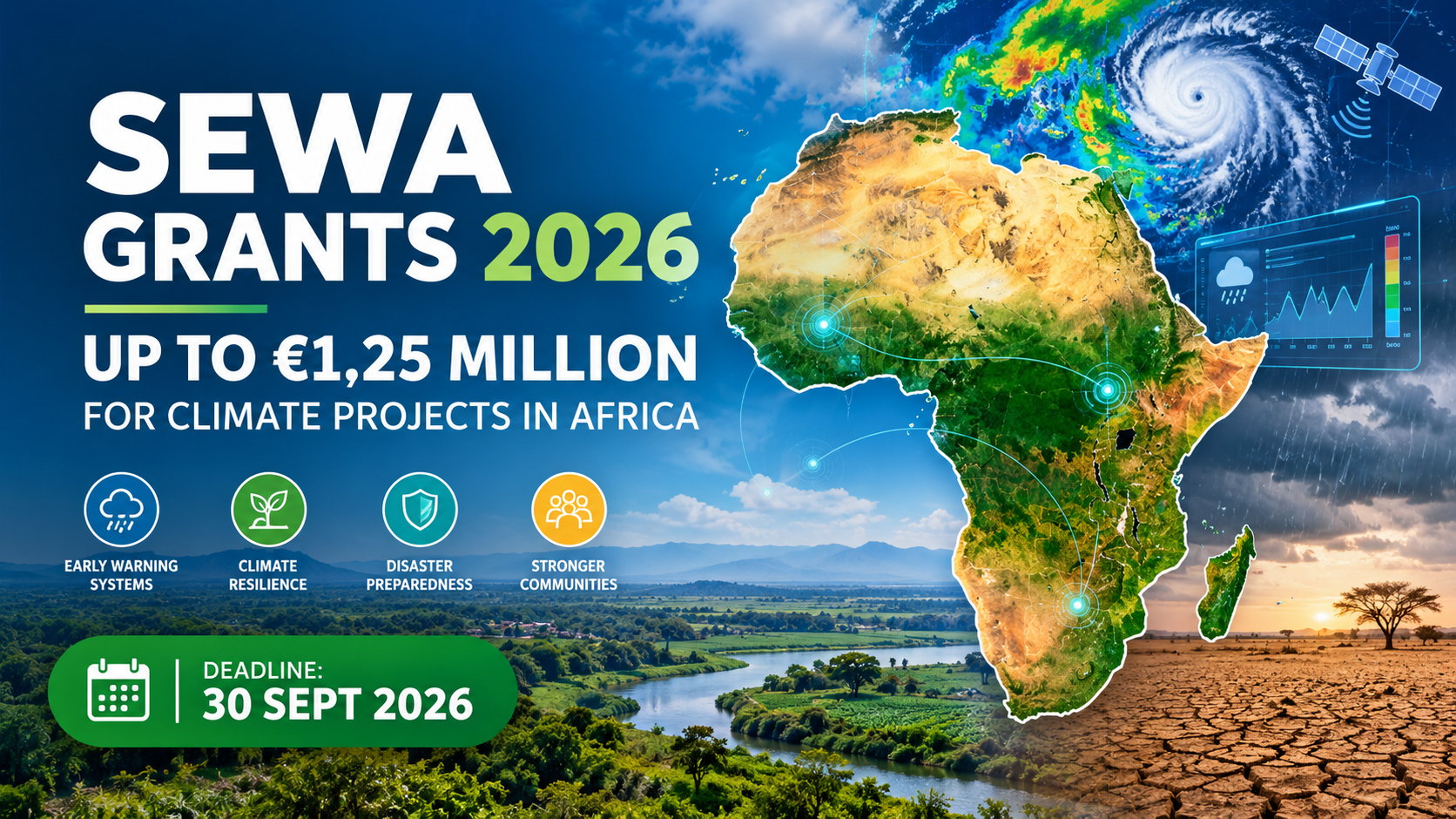

SEWA Grants 2026: Up to €1.25 Million Available for Climate and Early Warning Projects in Africa
“`Are you working on climate resilience, disaster preparedness, weather forecasting or early warning systems in Africa? The Strengthening Early Warning in Africa (SEWA) Grants 2026 are now open and could provide up to approximately €1.25 million per selected regional project.
Programme: Strengthening Early Warning in Africa (SEWA) Grants 2026
Focus: Climate resilience, forecasting and early warning systems
Region: Sub-Saharan Africa and Indian Ocean region
Maximum funding: Approximately €1.25 million per project
Project duration: Approximately 24 months
Deadline: 30 September 2026 at 14:00 CEST
What Are the SEWA Grants 2026?
“`The Strengthening Early Warning in Africa (SEWA) Grants 2026 are designed to support regional initiatives that improve the way African communities, institutions and decision-makers prepare for and respond to weather- and climate-related hazards.
The programme focuses on turning climate and weather information into useful, practical and timely warnings. Rather than simply producing forecasts, supported projects are expected to help ensure that information reaches the people and institutions that need it and can be translated into appropriate early action.
According to the published call, SEWA is led by the European Centre for Medium-Range Weather Forecasts (ECMWF) as part of the Africa-EU Space Partnership Programme and is funded by the European Union under the Global Gateway initiative.
“`How Much Funding Is Available?
“`Selected regional projects can receive up to approximately €1.25 million per project.
The funding is intended to support regional pilot projects capable of demonstrating practical approaches to strengthening climate information services, impact-based forecasting and early warning systems.
💶 Maximum Funding
Up to €1.25 Million
per selected regional project
Projects are expected to run for approximately 24 months, giving successful applicants time to develop, test and demonstrate regional solutions.
“`What Types of Projects Does SEWA Support?
“`SEWA is particularly interested in projects that make weather and climate information more useful and actionable for communities and institutions.
Supported projects may focus on areas such as:
- Weather and climate forecasting
- Early warning systems
- Disaster preparedness
- Early action and response
- Climate resilience
- Impact-based forecasting
A strong proposal should therefore demonstrate how better climate information can lead to earlier decisions and practical action before, during or immediately after a climate-related hazard.
“`Climate Hazards That Projects May Address
“`The SEWA programme recognizes a range of weather and climate-related hazards affecting communities across Africa and the Indian Ocean region.
🌊 Floods
Projects may improve warnings and preparedness for floods and flash floods.
🌾 Drought
Solutions can support communities facing drought and prolonged dry spells.
🌡️ Heatwaves
Early information can help vulnerable populations prepare for extreme heat.
🌪️ Dust Storms
Projects may improve forecasting and preparedness for dust-related hazards.
⛈️ Thunderstorms
Early warnings can help communities and institutions respond to severe storms.
🌀 Tropical Cyclones
Regional solutions can strengthen preparedness and early action in exposed areas.
Other weather and climate-related hazards may also fall within the scope of the programme where they are relevant to the proposed regional solution.
“`How SEWA Early Warning Projects Can Make a Difference
“`One of the important features of this funding opportunity is its emphasis on impact-based forecasting.
Traditional weather forecasting may tell people what weather conditions are expected. Impact-based forecasting goes further by helping answer an important question: What could those conditions mean for people, infrastructure, agriculture, businesses and essential services?
SEWA-supported projects are expected to combine different types of information, including:
- Weather information
- Climate information
- Exposure data
- Vulnerability data
- Local impact information
Combining these datasets can help produce warnings that are more relevant to the communities and decision-makers receiving them.
“`Who Can Apply for SEWA Grants?
“`This is not presented as a conventional individual or small-business grant. The call is structured around regional pilot projects and institutional consortia.
The regional pilots are expected to involve African WMO Regional Climate Centres working together with consortia of relevant African and European organisations.
Projects should also involve appropriate stakeholders, including National Meteorological and Hydrological Services, where relevant.
Geographic Scope of the SEWA Grants
“`The programme supports regional initiatives across Sub-Saharan Africa and the Indian Ocean region.
The geographic scope includes:
- Western Africa
- Central Africa
- Eastern Africa
- Southern Africa
- Indian Ocean Islands
This regional focus means applicants should think beyond a single-community intervention where appropriate and consider how their proposed solution can be tested, adapted or replicated across multiple countries or regions.
“`What Makes a Strong SEWA Grant Proposal?
“`Organisations considering this opportunity should avoid presenting a proposal that simply describes climate change as a problem. A competitive regional project should clearly explain the problem, proposed solution, beneficiaries, regional value and expected measurable results.
1. Clearly Define the Climate or Weather Problem
Explain the hazard being addressed and why existing forecasting or warning mechanisms are not sufficient. Use credible evidence and local or regional data where possible.
2. Explain the Proposed Innovation
Clearly describe what your project will develop, test or improve. This could involve new approaches to forecasting, data integration, communication, early warning dissemination or decision-making.
3. Demonstrate Regional Value
Because SEWA is focused on regional pilots, applicants should clearly explain why the project is relevant beyond one location and how lessons or solutions could benefit multiple countries, institutions or communities.
4. Identify the People Who Will Use the Information
Explain who will receive or use the warnings. Depending on the project, this could include government agencies, disaster-management authorities, farmers, humanitarian organisations, local governments, infrastructure operators or vulnerable communities.
5. Show How Early Warnings Will Lead to Early Action
A strong proposal should connect information to action. For example, explain what decision-makers or communities will do once a warning is issued and how the project will help reduce potential losses or disruption.
6. Establish Measurable Results
Include realistic indicators for measuring progress. Examples may include improved warning lead time, number of institutions reached, geographical coverage, improved forecast accuracy or the number of users able to take predefined early actions.
“`Application Deadline
“`APPLICATION DEADLINE
30 September 2026
14:00 CEST
Organisations interested in participating should begin preparing early because regional consortium applications can require coordination between several institutions and partners.
“`How to Apply for SEWA Grants 2026
“`Applications must be submitted electronically through the official ECMWF submission portal.
- Review the official SEWA call documentation carefully.
- Confirm that your organisation and proposed consortium meet the eligibility requirements.
- Identify the relevant African and European partners required for the regional project.
- Develop a clear climate or early-warning project concept.
- Define the expected outcomes, beneficiaries and measurable impact.
- Prepare the required technical and administrative documents.
- Register the coordinating organisation on the ECMWF submission portal.
- Complete the proposal electronically.
- Submit the application before the deadline.
According to the published information, registration of the coordinating organisation on the portal is free.
“`Who Should Consider This Opportunity?
“`The SEWA Grants may be particularly relevant to organisations and institutions working in areas such as:
- Climate resilience
- Disaster risk reduction
- Meteorology and weather forecasting
- Climate information services
- Early warning systems
- Impact-based forecasting
- Disaster preparedness
- Early action and response
- Climate adaptation
- Regional climate research
Organisations that already have partnerships with meteorological agencies, climate institutions, research organisations, humanitarian actors or regional development institutions may be particularly well positioned to explore the opportunity.
“`Why Climate Early Warning Systems Matter in Africa
“`Across Africa, communities can be highly exposed to floods, droughts, extreme heat, storms and other climate-related hazards. The value of an early warning system is not simply in predicting a hazard; its real value is in helping people and institutions take action before impacts become severe.
Better forecasting and communication can support decisions such as protecting infrastructure, preparing emergency services, moving livestock, safeguarding crops, relocating vulnerable populations and mobilising humanitarian resources.
This makes early warning systems an important part of wider climate adaptation and disaster-risk reduction strategies.
“`Important Things Applicants Should Know
“`✓ This is a regional opportunity.
The programme is designed around regional pilots rather than ordinary individual applications.
✓ Funding can be substantial.
Selected projects can receive up to approximately €1.25 million.
✓ Projects are expected to last around 24 months.
Applicants should therefore present a realistic implementation plan.
✓ Consortium requirements matter.
Organisations should carefully review the official documentation before assembling partners.
✓ The deadline is strict.
Applications are due by 30 September 2026 at 14:00 CEST.
✓ Verify information before submitting.
Always rely on the official ECMWF call documentation and submission portal for final eligibility, technical and application requirements.
Frequently Asked Questions
“`How much can a project receive?
Selected regional projects can receive up to approximately €1.25 million.
What is the SEWA Grants programme about?
SEWA supports regional projects designed to strengthen impact-based forecasting, early warning systems, climate services, disaster preparedness and early action across Africa.
What hazards can projects address?
Potential hazards include floods, flash floods, droughts, dry spells, heatwaves, dust storms, thunderstorms, tropical cyclones and other weather- and climate-related hazards.
How long will projects run?
Projects are expected to run for approximately 24 months.
Can an individual apply alone?
The opportunity is structured around regional pilots involving WMO Regional Climate Centres and relevant African and European organisations. Applicants should therefore review the official consortium requirements rather than assume that an individual application is eligible.
When is the application deadline?
The published deadline is 30 September 2026 at 14:00 CEST.
Where are applications submitted?
Proposals are submitted electronically through the official ECMWF submission portal.
“`Final Advice for Potential Applicants
“`The SEWA Grants 2026 represent an important funding opportunity for organisations developing practical solutions to climate and weather-related risks in Africa. However, the programme is highly specialised and should not be approached like a standard small-business grant.
Potential applicants should begin by identifying the specific climate or weather problem they want to address, determining the relevant regional partners, understanding the required consortium structure and developing a proposal that demonstrates how better climate information will result in measurable early action.
Most importantly, applicants should verify all eligibility, technical, consortium and submission requirements in the official SEWA documentation before submitting.
📌 SEWA Grants 2026 Quick Summary
- Funding: Up to approximately €1.25 million per project
- Focus: Climate, weather forecasting and early warning systems
- Geography: Sub-Saharan Africa and Indian Ocean region
- Project duration: Approximately 24 months
- Key hazards: Floods, droughts, heatwaves, storms, cyclones and others
- Application method: Electronic submission through ECMWF
- Deadline: 30 September 2026 at 14:00 CEST
Disclaimer
“`This article is provided for informational purposes and is based on information published by MSME Africa concerning the SEWA Grants 2026. Funding amounts, eligibility requirements, consortium requirements, documentation and application procedures may be subject to the official programme rules. Applicants should verify all information directly with ECMWF and the official SEWA call documentation before submitting an application. Do not pay anyone claiming to guarantee grant approval.
“`